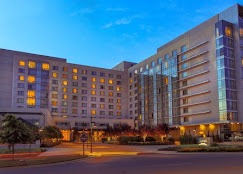
CFDE 2026 Spring Meeting
March 24-25, 2026
Bethesda North Marriott Hotel & Conference Center
5701 Marinelli Road
Rockville, Maryland, USA, 20852
Meeting Overview
This infographic provides a visual summary of the 2026 NIH CFDE Spring Meeting (March 24–25, Bethesda MD). The two-day face-to-face gathering brought together principal investigators, trainees, and junior scholars from across the Common Fund Data Ecosystem to share progress, showcase innovative tools, and chart future directions for biomedical data integration, interoperability, and training.
Conference Overview Dashboard
A snapshot of the CFDE Spring 2026 Meeting’s scale and engagement.
Session Distribution
Center Focus Areas
Agenda & Detailed Summaries
A chronological overview of the meeting sessions, with key discussions, presentations, and outcomes from each day.
Welcome & NIH Opening Remarks
9:00 – 9:30 AM Brookside C
- Jake Chen (ICC): Welcomed attendees and outlined the two-day agenda, including the technology showcase, poster sessions, and working group breakouts. Encouraged attendees to sign the CFDE marker paper (95 contributors already).
- Dr. Vivian Ota Wang (NIH, Acting Director, Office of Strategic Coordination): Underscored CFDE’s mission to accelerate biomedical discovery through data integration, interoperability, and fostering high-impact, high-risk science across Common Fund programs.
Session 1: R25 Updates (9:30 – 10:45 AM, Brookside C)
R25 programs develop short courses promoting use of Common Fund data. Training materials are made widely available for global access with proper citation for authors.
Jackson Labs — Gary Churchill
Week-long multi-omic data analysis course in Bar Harbor, Maine, designed for 30–35 students using project-based and team-based learning approaches.
Emory University — Judy Gajjoya
Simdar Hive Program — training researchers from resource-limited institutions, particularly in Africa, using medical imaging datasets via summer schools and datathons.
OHSU — Lisa Karstens
Human Microbiome Data Discovery course targeting early-career researchers; focuses on IHMP and Metabolomic Workbench datasets.
Session 2: Center Updates (11:00 AM – 12:00 PM, Brookside C)
Data Resource Center (DRC) — Lily Taub
- Enhanced search functionality using Elasticsearch for improved performance.
- New visual C2M2 graph search interface added to the CFDE Workbench.
- Progress on the Liver Portal project as a cross-center use case.
- Gene set crossing use cases for multi-program discovery.
- Integration of connectivity mapping resources for drug and target discovery.
- Project selection driven by brainstorming sessions focusing on highest-impact ideas.
Knowledge Center — Noel Burtt
- Year 1 → Year 3 evolution: developed Reveal, a reasoning engine for validated evidence across the CFDE landscape.
- Improved UI: gene clustering, enhanced data source transparency.
- Benchmarking results showing Reveal’s ability to confirm and extend findings from published papers (incl. a Nature Communications paper).
- Plans for a summer incubator event focused on scientific interoperability across NIH resources.
ICC (Integration & Coordination Center) — Jake Chen
- AI automation: new event entry via Google Forms and Slack.
- Launched the CFDE Talent Knowledge Graph — semantic embedding model connecting researchers with bioinformatics expertise and collaboration opportunities (presented by Zhandos).
- Ongoing coordination of newsletters, working groups, and steering committee meetings.
Training Center — LaFrancis Gibson
- New CFDE 101 module launching.
- DataViz Competition — call for 2–5 minute video submissions; judges being recruited.
- DECO Institute: 8-week mentor program launching summer 2026; registration opens April.
- Online repository of ready-to-use graphics and communication templates for community use.
- Community Source Modules RFP submissions being collected.
Cloud Workspace Interoperability Center (CWIC) Public Launch!
Public platform officially launched — accessible to academic researchers worldwide.
Galaxy environment providing computational tools and data processing capabilities at scale.
Access to authorized CFDE datasets with secure computing resources for academic institutions.
Session 3: Tech Showcase (1:00 – 2:00 PM, Brookside C)
3D Human Reference Body VR — Andreas Bueckle
R03 award project providing FAIR access to biomolecular datasets from HuBMAP, ZenNet, and GTEx via immersive Virtual Reality. The HRA Organ Gallery app allows users to interact with 3D reference organs, tissue registrations, and cell type populations. Next: deploying additional datasets and analyzing cell type population variability across annotation tools.
BiomarkerKB — Jeet Vora
A robust, data model-aligned knowledgebase for biomarkers of clinical importance. Unified biomarker information system integrating diverse resources. Portal live at biomarkerkb.org.
ChEA-KG Atlases — Anna Byrd
Transcription factor modules derived from CFDE datasets. Network of 1,559 human transcription factors with context-specific atlases: Cell Type Atlas, Cancer Atlas, MOA Atlas, and Aging Atlas. Includes time series tool for regulatory subnetwork creation.
GSFM — Daniel Clarke
Gene Set Foundation Model — a denoising autoencoder pre-trained on millions of gene sets from diverse collections. Outperforms state-of-the-art methods in gene function prediction, can predict missing genes, and has been applied to CFDE libraries.
New & Continuing Common Fund Programs (2:00 – 2:45 PM, Brookside C)
COMPLEMENT-ARIE New — Chris Duncan
Develops and validates human-based New Approach Methodologies (NAMs) to complement traditional animal models. Structure: Technology Development Centers (TDCs), centralized data hub, and Validation & Qualification Network (VQN).
5 TDC awards announced, focusing on:
Bridge2AI Phase II New — Laurel Kuxhuas
Two main initiatives for AI-enabled biomedical solutions:
- Innovation Funnels: Developing AI-enabled solutions for priority research challenges.
- AI Health Science Network: 3–5 centers focused on cross-cutting methodological topics in AI for health sciences.
Includes VQN: a public-private partnership with 4 pilot projects (brain development, compound harm, inhalation toxicity, preterm birth prediction).
Session 4: Junior Scholar Lightning Talks (2:45 – 3:30 PM)
Rapid-fire research presentations from junior scholars across CFDE-affiliated programs, covering a broad range of topics including multi-omic analysis, AI frameworks, protein structure, and data tools. Moderated to foster energy and cross-program connection among early-career researchers.
Poster Presentation & Judging (3:30 – 5:30 PM)
Broad poster session showcasing ongoing research across CFDE centers and affiliated programs. Topics spanned:
Session 5: Working Group Breakouts (Parallel) (8:30 – 10:00 AM)
Ontology WG
Discussions on C2M2 metadata standards, controlled vocabularies, and pending topics from previous OWG meetings.
Knowledge Graph WG
Community updates on KG development, LLM integration with KGs, and standards for cross-program interoperability.
Evaluation, Trainers & Comm. Outreach
Training initiative planning, evaluation metrics, outreach charter development, and communication resource coordination.
Session 6: Breakout Sessions (10:30 – 11:30 AM)
Community Engagement — Cathy Wu (UniProt)
Strategies for broadening CFDE community engagement through partnerships with major biomedical databases and data resources.
Tooling in the Cloud Workspace — CWIC Team
Deep dive into available tools, workflow integration, onboarding processes, and future roadmap for cfdworkspace.org.
MCP / Agentic AI / Chatbots / Vibe Coding — DRC Team
Exploration of cutting-edge AI approaches including Model Context Protocols, agentic AI systems, chatbot integrations, and emerging “vibe coding” methodologies for biomedical data analysis.
Metabotyping Partnership — Shankar Subramaniam
Collaborative discussions on defining human metabotypes across Common Fund datasets and cross-program partnership opportunities.
Session 7: Emerging Opportunities for Expanding User Base (12:45 – 2:45 PM)
Liver Resource
Presentation on the CFDE Liver Portal as a flagship cross-center use case demonstrating integrative analysis power, combining DRC metadata infrastructure with knowledge center analyses and cloud workspace compute.
Synergy with Communications & Outreach Group
Strategic alignment between scientific outputs and outreach activities. Discussion of cohesive communication strategies, event presence (ISMB, ASHG, etc.), and growing the CFDE user base through targeted messaging.
Cross-Cutting Themes & Highlights
AI & Agentic Tools
MCP/Agentic AI, GSFM, Reveal, Protein GPT, ChEA-KG time series, and AI-assisted report generation are transforming biomedical data analysis workflows.
Data Integration
Cross-program gene set crossing, Liver Portal multi-center collaboration, and C2M2 metadata standards enabling discovery across 13+ DCCs.
Training & Outreach
DECO Institute, CFDE 101, DataViz Competition, Hackathon, R25 short courses — expanding the CFDE user base from early-career to international researchers.
Key Tools & Platforms Discussed
Research Focus Areas
Poster Session Highlights
The poster session (Day 1, 3:30–5:30 PM) featured presentations showcasing diverse research leveraging CFDE resources across institutions and career stages.
Research Topics — Keyword Overview
Poster Highlights by Category
🧬 Omics & Disease Biology
- Drug Ranger: Connectivity mapping for drug-gene regulators (Lily et al.)
- MoTrPAC Exercise Biology: Acute exercise effects in sedentary adults
- Aging Atlas: Tissue-specific gene regulators via combined networks
- PRISM Framework: Multimodal molecular embedding integration
🛠️ Tool Development & Platforms
- CFDE Workbench: C2M2 graph search (John et al.)
- HRA Organ Gallery VR application (Andreas Bueckle)
- AI-Assisted Report Generation (Daniel et al.)
- ChEA-KG Time Series Tool (Anna et al.)
📊 Knowledge & Data Resources
- BiomarkerKB: Unified biomarker portal (biomarkerkb.org)
- CFDE Talent Knowledge Graph (Zhandos, Spark Center)
- GSFM: Gene Set Foundation Model (Daniel Clarke)
- Protein GPT: Protein-language alignment (Yija)
🌍 Training & Community
- Simdar Hive: Resource-limited institution training (Judy Gajjoya)
- Human Microbiome Data Discovery course (Lisa Carstens)
- Multi-omic data analysis — Bar Harbor course (Gary Churchill)
- CFDE DataViz Competition submissions
Participant Feedback & Impressions
Attendee evaluations highlight the continued value and community impact of the CFDE Spring 2026 Meeting.
Overall Meeting Satisfaction
“The public launch of cfdworkspace.org is a major milestone — finally giving researchers real access to the tools and datasets in one place.”
“The Reveal tool from the Knowledge Center was incredibly impressive — seeing it confirm and extend findings from published papers in real time was a highlight.”
“The breakout on MCP/Agentic AI opened my eyes to where CFDE is headed with AI tooling. Exciting to be part of this community.”
“The DECO Institute and Training Center initiatives are exactly what our students need — real mentorship connected to real data.”
Common Positive Themes
- Excitement around cfdworkspace.org public launch.
- High quality and diversity of Tech Showcase demos.
- Strong emphasis on AI-ready and FAIR data practices.
- Engaging junior scholar lightning talks and poster session.
- Valuable working group breakout sessions.
- Community-driven outreach tools and social media coordination.
- Appreciation for cross-center collaboration (e.g., Liver Portal).
- Accessible training programs for resource-limited institutions.
Moving Forward Together
The CFDE Spring 2026 meeting demonstrated the ecosystem’s continued momentum — from the public launch of Cloud Workspace at cfdworkspace.org, to breakthrough AI tools like Reveal and GSFM, to expanding training programs reaching researchers worldwide. The CFDE community remains committed to building an open, interoperable, and impactful biomedical data ecosystem.
2026 NIH CFDE Spring Meeting · March 24–25, 2026 · Bethesda, MD